
Circle’s Technical Strategy: Infrastructure Development Amidst Revenue Decline
Inside Arc Blockchain, Circle Payments Network, and the USYC Gamble

In Part 1, we examined Circle’s USDC business, highlighting its reliance on reserve interest (99% of income in 2024) and its sensitivity to rates ($441 million in income per point). We also reviewed the Coinbase partnership (54% of USDC distribution), Tether’s zero-reserve competition, the GENIUS Act’s regulatory effects, and Circle’s IPO plans. The main takeaway: as interest rates fall, Circle’s core revenue shrinks rapidly.
In this edition, we analyze Circle’s technical response to this revenue crisis: launching the Arc blockchain for payments, the USYC tokenized Treasury fund, and the Circle Payments Network for institutions. These efforts aim to create new fee income, though revenue impact is delayed.
Circle is in a tough spot. Each quarter-point drop in interest rates means about $110 million less in yearly revenue. At the same time, these new projects won’t bring in significant income until at least 2027. Circle is doing a good job on the technical front, but its main source of income is shrinking faster than the new projects can grow.
The strategic irony nobody mentions
Circle is investing heavily in building financial infrastructure that primarily benefits traditional financial institutions, not the DeFi ecosystem that first made USDC popular. Arc’s controlled validator set, CPN’s access restricted to institutions only, and USYC’s $100,000 minimum investment are all aimed at regulated banks and payment processors that already have operational systems.
These technical decisions help with regulatory compliance, but they raise a tough question: is Circle building a real competitive advantage, or just creating costly middleware that institutions might later avoid?
Arc: Fast settlement for institutions that trust Circle
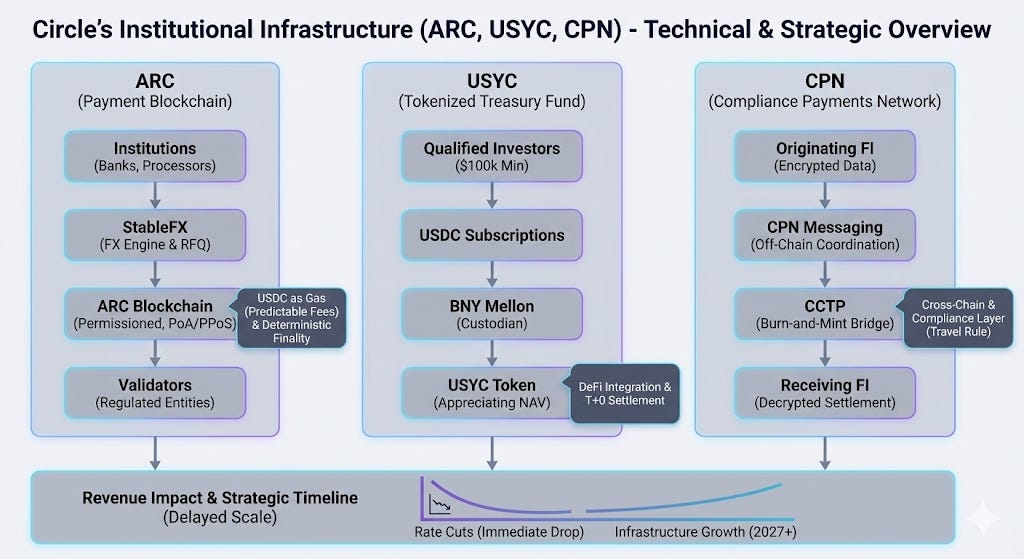
Arc is Circle’s new blockchain built for stablecoin payments. It works like a private highway where Circle decides who can join. The main idea is that regulated institutions would rather work with a trusted, compliant operator than deal with the risks of public blockchains.
Arc uses a consensus mechanism based on proven Byzantine Fault Tolerance algorithms, similar to what powers Cosmos and other enterprise blockchains. Circle got this technology from Informal Systems and rewrote it in Rust to boost performance. With 4 validators, Arc has demonstrated ~10,000 TPS with finality in less than 100 milliseconds.
The difference between lab results and real-world performance is important. Institutional networks need validators in different locations to meet regulatory and operational needs, not just high numbers from clustered data centers. Circle is upfront about these real-world tradeoffs.
Arc’s finality model is valuable for enterprise settlements. When two-thirds of validators approve a transaction, it’s final and there is no need to wait for more blocks or worry about reorganization. This matches Bank for International Settlements standards and makes Arc suitable for institutional settlements.
USDC as gas solves a real budgeting problem
Arc stands out by using USDC itself as the currency for transaction fees. There’s no wrapping or conversion, just native USDC used directly for gas costs at the protocol level.
This solves a big problem for enterprises. On most blockchains, gas fees can swing 20-40% each week as tokens like ETH change with the market. CFOs have a hard time budgeting when costs are unpredictable. Arc fixes this by setting gas fees in dollars and smoothing them over several blocks to keep them stable.
The implementation extends Ethereum’s fee market design with two practical modifications. First, fees average across recent blocks instead of reacting sharply to individual congestion spikes. Second, a hard cap prevents runaway fees during periods of extreme demand, sacrificing some economic efficiency for greater cost predictability. These aren’t novel technical innovations, but they address actual enterprise concerns.
Transaction fees are accumulated in an on-chain treasury & then paid directly to validators. Circle hasn’t specified its governance model or fee distribution rules, which are important for understanding long-term economic sustainability and also validator incentives. However, potential governance models could include a decentralized autonomous organization (DAO) structure in which stakeholders vote on how fees are distributed.
Alternatively, Circle might follow industry precedents, such as the model used by Cosmos, in which validators and delegators receive shares based on staking ratios and network participation. Clarity on these mechanisms would help analysts assess the alignment of validator interests and the network’s overall sustainability.
For stablecoins other than USDC, Arc uses Account Abstraction to automatically convert currencies via a built-in FX engine. This means an institution can pay fees in EURC, and Arc will handle the conversion in the background.
StableFX reveals who Arc is really for
Circle promotes StableFX as Arc’s built-in foreign exchange feature, and its design shows who it’s meant for. StableFX isn’t a DeFi automated market maker. Instead, it uses an institutional Request-for-Quote process: institutions submit requests via an API, several liquidity providers compete, the best quote is selected, the trade happens quickly off-chain, and smart contracts ensure settlement is atomic.
This is how traditional FX markets currently work, adapted for blockchain settlement. RFQ preserves bilateral relationships & credit arrangements while also providing settlement finality. Access is explicitly permissioned with KYB/AML verification as a requirement.
Some crypto-native participants may view this as overly centralized. However, for institutions accustomed to credit and settlement risk in traditional FX markets, atomic settlement combined with permissioned access offers operational improvements while maintaining familiar processes.
The validator question Circle can’t avoid
Arc launches with Proof-of-Authority: a fixed set of institutional validators chosen by Circle. The testnet runs on 20 nodes selected for operational stability, regulatory compliance, and geographic diversity. This is consortium architecture that prioritizes accountability through identity over accountability through staked capital.
Circle describes this as “decentralized” since several entities are responsible for running validators. Critics argue it’s still centralized because Circle controls who the validators are. The network could stop if Circle asked validators to stop. There are plans to move to a “Permissioned Proof-of-Stake,” where qualified entities can stake and earn rewards, but there’s no set timeline or clear requirements yet.
Circle’s approach is simple: it believes regulated institutions want accountability based on reputation and licensing, not anonymous staking. Whether banks and payment processors are interested enough in blockchain settlement to join governance will decide if this model works in the market.
USYC: The tokenized Treasury with smart design choices
USYC, Circle’s tokenized Treasury fund bought from Hashnote in January 2025, is designed with DeFi integration in mind. The token’s balance stays the same, but its price goes up as yield builds. This is different from rebasing tokens like BlackRock’s BUIDL, where the number of tokens increases but the price stays at $1.
The appreciating model simplifies DeFi dramatically. Price oracles work naturally & the lending protocols does not need to have custom logic to change balances, and holders avoid tax complications from rebase events. The tradeoff is more complex capital gains accounting, but institutions focused on DeFi composability prefer this approach.
The product structure is very straightforward: USDC subscriptions convert to USYC tokens at the current NAV & tokens can be transferred on-chain subject to set permissions. Daily NAV updates reflect the underlying Treasury portfolio’s performance and redemptions convert back to USDC with T+0 settlement. Underlying assets sit at BNY Mellon in segregated custody. Minimum investment is $100,000.
USYC showed its value in DeFi by backing Usual’s USD0 stablecoin which reached a peak AUM of about $1.2 billion in December 2024. When Usual had governance problems and users exited quickly, USYC’s AUM fell by more than 20% in just a few weeks. Depending on the source and date, current AUM is between $487 million and $1.2 billion.
This volatility highlights a big risk: when 97% of your assets are tied to one DeFi protocol, you’re exposed to that protocol’s operational and governance issues, no matter how well you manage your own Treasury.
At the current scale, USYC generates approximately $1-$2.5 million in management fees annually. This is not material to Circle’s business. AUM would have to increase by 10x to generate revenue comparable to a single quarter-point move in USDC reserve rates.
CPN: Compliance-first payments architecture
Circle Payments Network went live in May 2025 with a practical design, it uses off-chain APIs for coordination & compliance, and on-chain smart contracts for settlement. This setup recognizes that institutions need regulatory features such as Travel Rule data exchange and sanctions screening, which aren’t suited to public blockchains.
The payment process separates managing relationships from final settlement. Originating Financial Institutions ask CPN for quotes, get responses from Beneficiary Financial Institutions, create payment requests with encrypted compliance data, and wait for approval. Once approved, CPN creates an on-chain transaction that settles using smart contracts on Ethereum, Polygon, or Solana, depending on the payment corridor uses an end-to-end encryption. Originating institutions can encrypt the sender and recipient information that only the receiving institution can decrypt, transmit via CPN’s messaging system, and beneficiary institutions verify compliance before approving settlement. This keeps sensitive data off-chain while preserving blockchain settlement finality.
For cross-chain transfers, CPN uses CCTP (Cross-Chain Transfer Protocol), Circle’s own burn-and-mint bridge. USDC is burned on the source chain, Circle verifies the burn, and the same amount of USDC is minted on the destination chain. In fast mode, this takes less than 30 seconds using Circle’s capital buffer. In standard mode, it takes 13-19 minutes to wait for finality.
CPN currently operates four active corridors: US to the Philippines, US to Mexico, Singapore to Indonesia, and Singapore to Thailand. More than 100 institutions are in the integration pipeline, but only those four corridors have actual production volume.
Revenue math shows the timeline gap.
Circle’s S-1 filing states explicitly: “we do not have any plans to launch…products that are expected to generate material amounts of fee-based revenues at this time.” Let’s check that claim against the numbers.
Arc gas fees at a 3,000 TPS capacity, with average transaction fees of $0.01-0.05, would generate $26-131 million annually at full utilization. This assumes mainnet launches in 2026, institutions migrate material transaction volumes, adoption reaches full capacity, and treasury governance doesn’t redirect revenue elsewhere. Realistic material contribution could only happen by 2027 or later.
CPN processes payments through four corridors with a pipeline of 100+ institutions. Transaction fees, FX spreads, and network access charges help cover infrastructure costs. With only four corridors generating actual settlement volume and no disclosed revenue numbers, a material contribution seems unlikely before 2026.
With $487-912 million in assets, USYC earns $1-2.5 million in management fees at an expense ratio of 0.20-0.25%. The recent 20%+ drop in AUM due to issues with the Usual protocol underscores the risks of relying on a single source, so growth expectations should be cautious. AUM would need to grow tenfold to match USDC reserve income.
The strategic timeline problem is clear: interest rate cuts affect USDC revenue immediately, with each percentage-point decline reducing revenue by $441 million per year. These infrastructure initiatives won’t reach material scale for years. Circle is executing correctly from a product standpoint while racing against accelerating revenue erosion.
Competitive positioning reveals the tradeoffs.
Arc competes with Avalanche subnets, Polygon CDK, and Cosmos zones for institutional blockchain adoption. Arc’s advantages include dollar-denominated gas fees (cost predictability), deterministic finality (no confirmation uncertainty), and integrated access to the Circle platform (CPN, USDC, USYC work together). Disadvantages are equally clear - more centralized than permissionless alternatives, no established developer ecosystem, and limited validator participation compared to public chains.
CPN competes with RippleNet’s On-Demand Liquidity for cross-border stablecoin payments. USDC avoids XRP’s volatility, supports multiple blockchains, and enables complex payment flows via smart contracts. RippleNet has a big headstart and strong corridor relationships, but USDC’s regulatory clarity under new stablecoin rules could be a key advantage for compliance-focused institutions.
USYC competes with BlackRock’s BUIDL for market share in the tokenized Treasury market.USYC’s appreciating token model integrates more naturally with DeFi protocols, while BUIDL’s rebasing maintains stable NAV for traditional collateral use cases. BUIDL has a 2.5x AUM advantage ($2.5 billion vs $900 million) and BlackRock brand recognition. USYC demonstrated superior DeFi composability but also showed vulnerability to protocol concentration risk.
The risks focus on the main risk for Arc: how quickly institutions will adopt it. Building the blockchain is the easy part, getting banks to actually move their payment volumes is much harder. Each bank needs months to evaluate, integrate, and get regulatory approval. Even if Arc works flawlessly, adoption could still take years.
USYC’s concentration risk materialized in real time. When 97% of AUM depends on a single DeFi protocol, and that protocol hits governance issues, you lose 20% AUM in weeks regardless of Treasury management quality. Diversification across multiple institutional clients and DeFi protocols will take time to build.
CPN’s complexity in working across Ethereum, Polygon, and Solana blockchain networks creates execution risk. Settling payments with different finality times takes really careful engineering. CCTP depends on Circle’s Attestation Service that is efficient but also comes with centralization. Meeting Travel Rule requirements in different countries adds more operational challenges.
The fundamental question isn’t whether these products work technically (they do) but whether institutions will adopt blockchain infrastructure fast enough to replace Circle’s reserve income business before rate cuts complete their damage.
What Circle actually accomplished
Circle has built advanced infrastructure with real innovation for enterprise needs. Using USDC for gas fees solves a very critical cost-prediction issue. CPN’s hybrid design meets regulatory needs, and USYC’s appreciating token model makes DeFi integration easier.
But every architectural choice prioritizes institutional acceptability & adoptability over permissionless decentralization. The validator set is curated, the payment network is hub-and-spoke with Circle as operator, and the fund requires a $100,000 minimum investment.
The technical roadmap and execution so far are solid. The strategic question is whether Circle can execute institutional adoption fast enough to matter for the timeline problem they face. That’s not a technical challenge; it’s a sales-cycle and regulatory-approval challenge that won’t be solved by better consensus algorithms or smart contract design. Circle is building real, working products. The big question is whether these will bring in enough revenue before USDC reserve income is cut in half, that’s the main uncertainty for anyone looking at Circle’s future.